Monday, February 6, 2012

A couple of projects completed


I wanted to make a new table runner and found a charm pack online at Nancy's Notions called "Le Petite Ecole" which looked like blue and red and cream and when I got it, it was more gray than blue. In the dead of winter I really need something bright but since I had the fabric, I went ahead and made it up. I had bought a book a while back called "Piece In the Hoop" which contains instructions and a CD with design files for piecing quilt blocks using the embroidery machine. I thought this would be a good time to try out those designs. I watched the video (basically a "Sewing with Nancy" type format) and read, or rather flipped thru, the book and got started.
Rather than make the test block and start with the simpler projects, I thought I would jump straight to the more complicated designs (the Log Cabin Block) (mistake #1). Also, wouldn't it make sense to make ONE block first and make sure all was going as planned? (mistake #2) Instead, I made up about 10 Log Cabin Blocks, trimmed them neatly, admired them for a while, then proceeded to make the Snowball Blocks with the embroidered chicken/rooster in the center. Then I cut all the plain pieces to fill in the other squares. It was only then, when I went to sew them all together, and the blocks didn't all match up, that I realized I'd FAILED to READ and FOLLOW directions. What I thought was the CUTTING line was actually the STITCHING line. So... I'd cut off all my seam allowances on the Log Cabin blocks (ahhhh!!!!!), which meant I had to cut down all the other blocks, and it snowballed from there. Disgusted, I wanted to throw the whole mess out, but I kept going. The casual observer can't see that the outer row on each Log Cabin Block is a wee bit narrower than the rest.


These pictures are dark because my dining room is dark, that's why I need bright cheery fabrics!
This table runner did provide a lot of really good practice. It was not a quilt as you go project. I used the "stitch in the ditch" for the log cabin blocks and for some of the plain blocks I used a design on the CD which kinda looks like candlewicking. For the rest I just did plain old machine embroidery.


Had I followed the directions it would have been a fast and easy project. The blocks stitch accurately every time. I can only imagine what it would have looked like if I'd tried to piece them myself!
The other project is a lingerie bag, ordered by a woman who buys toddler dresses from us. She has a lingerie shower to go to and had an idea of what she wanted and basically sketched an envelope shape with the recipient's monogram. She provided the cotton outer fabric and a flower button. The cotton wasn't sturdy enough for a bag so I created quilted fabric by using sew in interfacing as the bottom layer, thin poly batting in the center and the cotton on top. I drew chalk lines 1" apart, in a diamond pattern and used an olive green embroidery thread on top. The quilting was easy and very fast. I loved the way it turned out.

The fabric is so busy I knew a monogram would be lost on it, so I used a "frame" of a light ivory and fuschia fabric (which I also used for the lining). I used Monogram Wizard to create the monogram. The frame is an applique also done in the embroidery machine.

Wednesday, January 25, 2012

Are you prepared for a Zombie Apocalypse?

If you're ready for a zombie apocalypse, then you're ready for any emergency. emergency.cdc.gov

According to the Center for Disease Control (CDC), if you're prepared for a Zombie Apocalypse, you're prepared for any emergency.

This morning we awakened to a tornado warning and watch. The skies were green, the wind was howling, rain pounding down, etc. I immediated went under the stairs... and I realized that we were NOT prepared. We need a "Bug Out Bag" (or Disaster Kit).

This Kit is to contain items you need to survive during the period between a distaster/emergency and the time help arrives, usually 72 hours or more. I recall my Mother talking about being prepared in the early 60's for a Russian nuclear attack by having boxes of emergency supplies in the car. Being a military wife, she knew what to have on hand. Since that time we've gotten lazy. We expect that FEMA, friends, family or SOMEONE will come to our aid. Hurricane Katrina should have made us all realize that isn't going to happen.

According to the CDC's website, here's what we should do to prepare for a natural disaster or emergency situation:

Gather Emergency Supplies
If disaster strikes your community, you might not have access to food, water, or electricity for some time. By taking time now to prepare emergency water supplies, food supplies and disaster supplies kit, you can provide for your entire family.

Even though it is unlikely that an emergency would cut off your food supplies for two weeks, consider maintaining a supply that will last that long.

You may not need to go out and buy foods to prepare an emergency food supply. You can use the canned goods, dry mixes, and other staples on your cupboard shelves.

Having an ample supply of clean water is a top priority in an emergency. A normally active person needs to drink at least 2 quarts (a half gallon) of water each day. You will also need water for food preparation and hygiene. Store at least an additional half-gallon per person, per day for this.

Store at least a 3-day supply and consider storing a two-week supply of water for each member of your family. If you are unable to store this much, store as much as you can. You can reduce the amount of water your body needs by reducing activity and staying cool.

And don't forget to take your pets and service animals into account!

Disaster Supplies Kit

A disaster supplies kit is a collection of basic items that could be needed in the event of a disaster. Assemble the following items to create kits for use at home, the office, at school and/or in a vehicle:

•Water—one gallon per person, per day (3­day supply for evacuation, 2­week supply for home)
•Food—non­perishable, easy­to­prepare items (3­day supply for evacuation, 2­week supply for home)
•Flashlight
•Battery­powered or hand­crank radio (NOAA Weather Radio, if possible)
•Extra batteries
•First aid kit
•Medications (7­day supply) and medical items
•Multi­purpose tool
•Sanitation and personal hygiene items
•Copies of personal documents (medication list and pertinent medical information, proof of address, deed/lease to home, passports, birth certificates, insurance policies)
•Cell phone with chargers
•Family and emergency contact information
•Extra cash
•Emergency blanket
•Map(s) of the area

Consider the needs of all family members and add supplies to your kit. Suggested items to help

meet additional needs are:

•Medical supplies (hearing aids with extra batteries, glasses, contact lenses, syringes, cane)
•Baby supplies (bottles, formula, baby food, diapers)
•Games and activities for children
•Pet supplies (collar, leash, ID, food, carrier, bowl)
•Two­way radios
•Extra set of car keys and house keys
•Manual can opener
Additional supplies to keep at home or in your kit based on the types of disasters common to your area:
•Whistle
•N95 or surgical masks
•Matches
•Rain gear
•Towels
•Work gloves
•Tools/supplies for securing your home
•Extra clothing, hat and sturdy shoes
•Plastic sheeting
•Duct tape
•Scissors
•Household liquid bleach
•Entertainment items
•Blankets or sleeping bags

Pack the items in easy-to-carry containers, label the containers clearly and store them where they would be easily accessible. Duffle bags, backpacks, and covered trash receptacles are good candidates for containers. In a disaster situation, you may need access to your disaster supplies kit quickly - whether you are sheltering at home or evacuating. Following a disaster, having the right supplies can help your household endure home confinement or evacuation.

Make sure the needs of everyone who would use the kit are covered, including infants, seniors and pets. It's good to involve whoever is going to use the kit, including children, in assembling it.

Disaster Supplies Kit Checklist for Pets


•Food and water for at least three days for each pet, food and water bowls and a manual can opener
•Depending on the pet, litter and litter box or newspapers, paper towels, plastic trash bags, grooming items, and household bleach
•Medications and medical records stored in a waterproof container, a first aid kit and a pet first aid book
•Sturdy leashes, harnesses and carriers to transport pets safely and to ensure that your pets cannot escape. A carrier should be large enough for the animal to stand comfortably, turn around, and lie down. Your pet may have to stay in the carrier for hours. Be sure to have a secure cage with no loose objects inside it to accommodate smaller pets. These may require blankets or towels for bedding and warmth and other special items
•Pet toys and the pet's bed, if you can easily take it, to reduce stress
•Current photos and descriptions of your pets to help others identify them in case you and your pets become separated, and to prove that they are yours
•Information on feeding schedules, medical conditions, behavior problems and the name and telephone number of your veterinarian in case you have to board your pets or place them in foster care.

Additional Supplies for Sheltering-in-Place

In the unlikely event that chemical or radiological hazards cause officials to advise people in a specific area to "shelter-in-place" in a sealed room, households should have in the room they have selected for this purpose:

•A roll of duct tape and scissors
•Plastic sheeting pre-cut to fit shelter-in-place room openings. Ten square feet of floor space per person will provide sufficient air to prevent carbon dioxide buildup for up to five hours. Local officials are unlikely to recommend the public shelter in a sealed room for more than two-three hours because the effectiveness of such sheltering diminishes with time as the contaminated outside air gradually seeps into the shelter.

Always keep a shut-off valve wrench near the gas and water shut-off valves in your home.

For more information on how to prepare, check out the CDC's website at:


Friday, January 13, 2012

A little on the Wild Side


I've been wanting to make a Sweatshirt Cardigan/Jacket for myself for a while now. I bought a supply of sweatshirts from Nancy's Notions when they were on sale. They were around $11 each. They come in just about any color and they fit comfortably and reliably.

Last year my friend Beth and I went to a quilt store and took an informal class on sweatshirt to cardigan transformation. My jacket turned out cute but since I started with a white Wal-Mart sweatshirt it never fit quite right. I found, after buying a couple more, that Wal-Mart sweatshirts shrink (in all the wrong places) and are NOT true to size.

After washing and drying the sweats from Nancy's Notions they still fit perfectly. I bought an XL and after cutting the ribbing off, I had to cut the sleeve length by a few inches and take up the underarm seam. Otherwise I had no fitting issues. I chose not to make a fitted jacket but I could have added darts (maybe on another one).

So I had this pile of sweats to choose from ... where to start? I had made Caroline an embroidered 3/4 sleeve t-shirt for Christmas, starting with a brown shirt and appliques out of brown "pleather", giraffe print and cheetah print. I liked the way it turned out so I decided to start with the same design for my jacket.

This jacket was basically made just like the one I made for Journey for Christmas. I cut off the wrist, waist and neck ribbing, and cut down the center. I used fusible interfacing to stabilize the neck and front opening. Next time I'll just stay stitch.

I only had a small amount of the trim fabrics so I had to use them wisely. I made bands to go around the bottom of the jacket as well as the sleeves. I used the last little bit of the cheetah fabric for neck and front binding. The cheetah and giraffe are knit prints I got at JoAnn's and were easy to work with. I bought the faux leather at a yard sale. {Sidebar note: I made a Roman Shade for my bathroom window out of this pleather because I got it cheap and I had a lot of it but word to the wise: you DO NOT want to try to iron it, so pick a project that doesn't require a lot of pressing.}

I sewed the first band to the bottom edge of the sweat so that I folded it to the right side and it was hemmed. I then basted the pleather band in place, then topstitched the animal prints to it. That was all very quick and easy.


Sleeve detail:


In order to sew the bands to the sleeve, it was necessary to rip the sleeve seam up above where the highest band would be stitched, then stitch the seam back together when done.

After all the bands were in place I could see where the appliques would go. I knew I wanted three stacked crosses appliqued on the back, which I did first. Because I used really large appliques it took two hoopings. In order to avoid "hoop burn" I secured the jacket by first using iron on stabilizer on the inside back of the jacket, and sticky stabilizer in the hoop. I then just placed the jacket on the hoop, smoothed it in place and pinned securely.

I chose a simple zig zag finish for the appliques. This particular design also comes with a satin stitch and a "vintage" stitch as well, but I wanted fast and easy so zig zag was the way to go. I went around the edge twice. For the front I used the same design, but in a smaller size.

I then added hot-fix crystals in a brown/copper color.


Jacket back:


Saturday, December 24, 2011

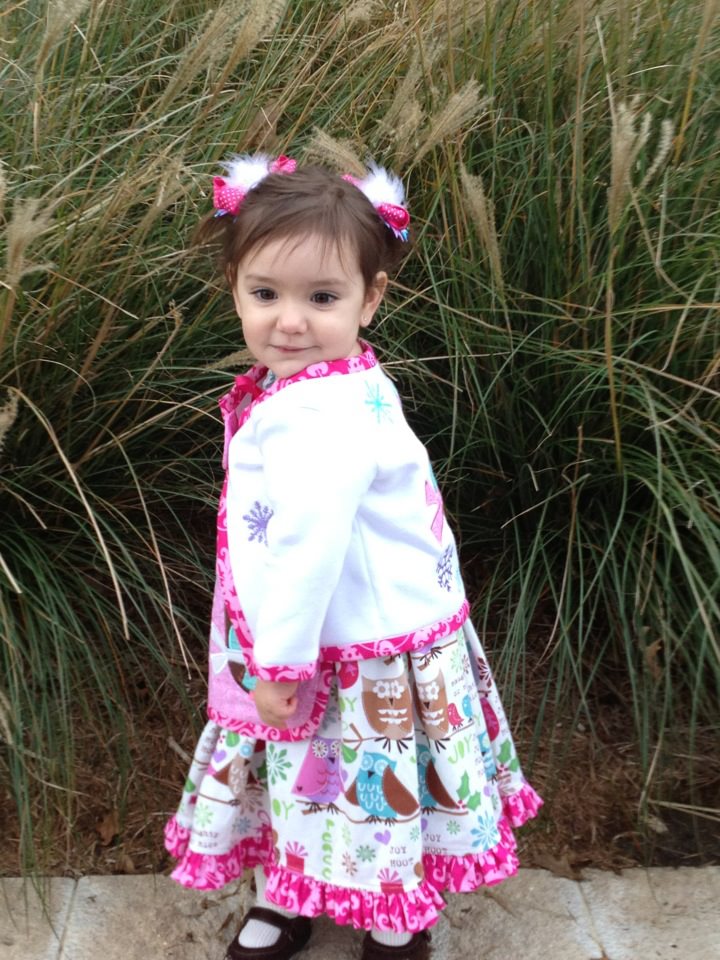
Journey in her Christmas Dress


{Journey modeling the Christmas dress that Grandma made for her}


Friday, December 23, 2011

The Stockings Were Hung . . .


My Grandma Gray made a felt stocking for me when I was litle. I still have it, but it has a few moth holes, which tells me she made it with wool felt. She also made tree skirts, door knob hangers, and tablecloths, all from felt. She made a table cloth which was essentially red net with appliques out of felt. I think Dana has that. One of these days I would like to copy it. Grandma Gray also made my mother's tree skirt (I'm not sure who has it now) and one for me when Elizabeth was a baby. She appliqued a baby on it and embroidered Elizabeth or Liz, I can't remember now - I gave the tree skirt to Liz.

My mom made Elizabeth's stocking when she was little too. And Liz made one for Rylan. Rylan didn't need another one, but I had some stocking stuffers for her and it's just not the same without a stocking. So before I mailed her Christmas gifts, I made this one with the embroidery machine. I used a water soluble pen and traced the stocking shape on red felt, but didn't cut it out. I had to hoop the felt twice to get all of the snowflakes on this full size stocking. After embroidering, I cut out the stocking shape, front and back. I embroidered the name on white felt, then made the scalloped edge on the sewing machine freehand. I then stitched it all together. It was very fast and easy.

While my mother made Elizabeth's stocking, I bought a knitted stocking for Caroline when she was little and made one for Stephanie using a pre-printed, pre-quilted stocking panel (26 years ago...). Caroline contends that because it's store-bought, she never had a proper stocking. So, about 10 or more years ago, I bought a felt stocking kit to make for her. Looking back, I realize that I must have bought THE most complicated design they had. Every year I think I will get it done and Caroline gives me a hard time when it's not . . . but this year - I finished it!!

Wednesday, December 21, 2011

Homemade Christmas, the Mud Room and Food Storage


{Bay Leaf Wreath}


Last year we had a Homemade Christmas. I had wanted to do it for a long time. Turns out it was a LOT of pressure. In my usual form, I procrastinated till the last minute and then didn't get everything done that I wanted to do. Also, I didn't get pictures of most of the things I made.


Some of the gifts were surprising. Those who thought they couldn't make anything came up with some great gifts. Frank made me a fleece blanket and a Texans cap/coat rack for Marc. Stephanie made Marc monogrammed socks (he goes through socks like crazy) and me a gift basket with home made bath products. Caroline made me a turquoise necklace and Marc a Texans fleece blanket. These are just some of the great gifts that were exchanged.


{View of Mudroom from Kitchen}

When we built the mud room we originally thought we would build cabinets on one wall. We decided against that and so Marc made me a large cabinet to be used as a pantry. It was my Christmas gift from him last year. It's quite large (about 3 feet wide and 7 feet tall and 2 feet deep). I use it for overflow pantry storage (since I don't have a proper pantry) and some small appliances that I don't use very often. I also store home canned items in it. I quickly filled it up, so he made another one for me this Christmas. I knew he was building it but one day I walked thru the mud room to do some laundry and when I came out I was shocked to see that he had moved the extra refrigerator out to the shed and moved the cabinet in. I had totally missed it as I walked past it several times.


{Mudroom}


{2010 Cabinet}


I've got wheat and my Excalibur wheat grinder in this cabinet, as well as some small appliances like the bread machine and crock pots, sugar, home canned foods, etc.


{2011 Cabinet}
In the new cabinet, Marc built the shelves a little closer together so I can get more smaller items stored. The very top shelf is lower on the front and higher in the back and has a lip on the front, so that I can put cans on it and they will roll forward. I have 4 cases of canned goods on this shelf already and there's room for more. I have rice, oats, beans, and more stored in this cabinet. I organized everything and took an inventory of what I had in there. I was surprised to see just how much I had stored, but there's still room for more. I've been shopping sales and stockpiling sale items and it adds up pretty quickly. After Christmas I'll do a post about home food storage or "stockpiling".


Marc even went in my craft room and found some Christmas stamps and even hand made gift cards:

Tuesday, December 20, 2011

Another Quilt As You Go Table Runner


I'm officially in love with making Quilt As You Go table runners. They are SO fast and easy. I bought a Charm Pack from Nancy's Notions sometime this year when it was on clearance, for like $2.50. It's by Deb Strain for Moda, but that's all I can remember. Anyway, the colors and designs are so modern. I originally thought I would use this to make a patchwork dress/jumper for Journey for Christmas, but after tearing up the attic looking for that pattern (I'd saved it from a Woman's Day magazine from the early 80's), I abandoned that idea. Maybe next year for that project.


I arranged the squares the way I wanted them and then sewed three together to make a strip. I then cut the red broadcloth into strips two inches wide for the sashing. I layered quilt batting over the backing fabric and used temporary spray adhesive (which I use in machine embroidery quite often) to hold them in place. Since this is a short runner (36") I started at one end with a red sashing strip. I stitched as described in my previous post about QAYG table runners. Pressed for time (surprised?) I serged the edges then stitched jumbo red ric rac to the edges. We use this ric rac all the time in making dresses for little girls for sale. We buy it at Hobby Lobby when it's half price. Each roll holds about 9 yards or maybe it's 9 feet, anyway, it's about $2 per roll and comes in a lot of fun colors. The first time I used it I washed and dried it to ensure that it was colorfast - it is.


The charm pack made TWO table runners this size. Plus there were a few charms that were left over that I didn't want to incorporate into this project. I used those on Rylan's scarf and Journey's Christmas dress.