Wednesday, November 16, 2016

Fun in Kindergarten


Home schooling was a family affair this past year.  Mom and Grandma taught Kindergarten (and PreSchool to little Sis). We were fortunate to have space to create a fun school room.  We painted the walls and floor, installed a white board, bulletin board and Mom created a fun life size 3-D tree. Our theme was "Owls".  We set up the play kitchen and light table.

Dad painted some vintage school desks in aqua and pink.  We found that the more modern desk/tables were preferred by the girls.  They have a larger flat surface and weren't so confining.

Aunt Dana provided a really fun language arts curriculum - "Sing Spell Read and Write".  We used colorful posters, music, songs, games and more.  We used Singpore Math for the math curriculum.  We tried to incorporate lots of fun into the lessons.


Saturday, November 5, 2016

Paprika Peppers

Fresh Paprika Peppers
This year's tomato crop would probably seem large to most people, but it was a small one for us.  We had about 125 plants in all - about 1/3 of the usual number.  The first few trays of seedlings died (due to operator error).  So, since the harvest would be smaller, salsa was the number one product we wanted to put up.

I have shared the Salsa Recipe I use before, but for the last couple of years we have been adding something extra - about 1 tablespoon of SMOKED paprika.  This really is the best salsa we've ever made, and really the smoked paprika is the difference.

We have canned about 65 jars of salsa and that's got to last us till next tomato season. That's just slightly over 1 jar per week. In our minds, that's not much at all!

I had never tried smoked papriks until sister Dana picked some up at a really neat spice and meat processing supply shop called Townsend Spice in Melbourne, Arkansas, and ever since I tried it, I'm hooked.  I love it. 

I set out on a quest to make my own smoked paprika.  It seemed simple enough - find paprika pepper seeds, plant them, harvest peppers, smoke, dry, grind, etc.

The first challenge was finding paprika pepper seeds.  I only found a couple of different sources on the internet.  I ended up buying seeds from Baker Creek Heirloom Seeds.  They carry two varieties, and I bought the Leutschauer Paprika Pepper.  They are supposedly originally from Hungary.  The package contained only 25 seeds and almost all seeds germinated.  The plants stayed quite small (probably because we neglected the seedlings) but produced a lot of peppers.  They are a lipstick red when ripe. 
Peppers in the dehydrator
The fresh and dried peppers are too hot for my taste, even though I remove the seeds and membranes before drying.  My next experiment will be to cook the peppers before drying them.  Cooked jalapenos don't seem nearly as hot so I am hoping this will help the paprikas as well.


Monday, October 17, 2016

Christening Gown from Grandmother's 1942 Wedding Gown


This a christening outfit I made from a wedding gown originally made and worn in 1942! It was made for my customer's grandmother.  Then her mother wore it (from the pictures - below - looks like it was the early 80's).  It had not been altered to fit her mother.

The gown was machine and hand stitched.  The seams were pinked inside - not something you see often. The fabric was silk satin and absolutely beautiful.  It was cream, but in certain light, looked almost buttery.  It hadn't been stored well after the last wearing and had some rust spots (from the hooks and eyes).  But since it had a train there was plenty of fabric to work with.  My customer had no children but her sister was having one soon and she thought she should do something with the gown before it deteriorated.  Her mother had passed away so it was even more special.

Grandmother in gown 1942

Mother wearing gown at her wedding
My customer wanted the finished christening gown to be unisex.  She also wanted her grandparents' and parent's' names and wedding dates embroidered on the slip.


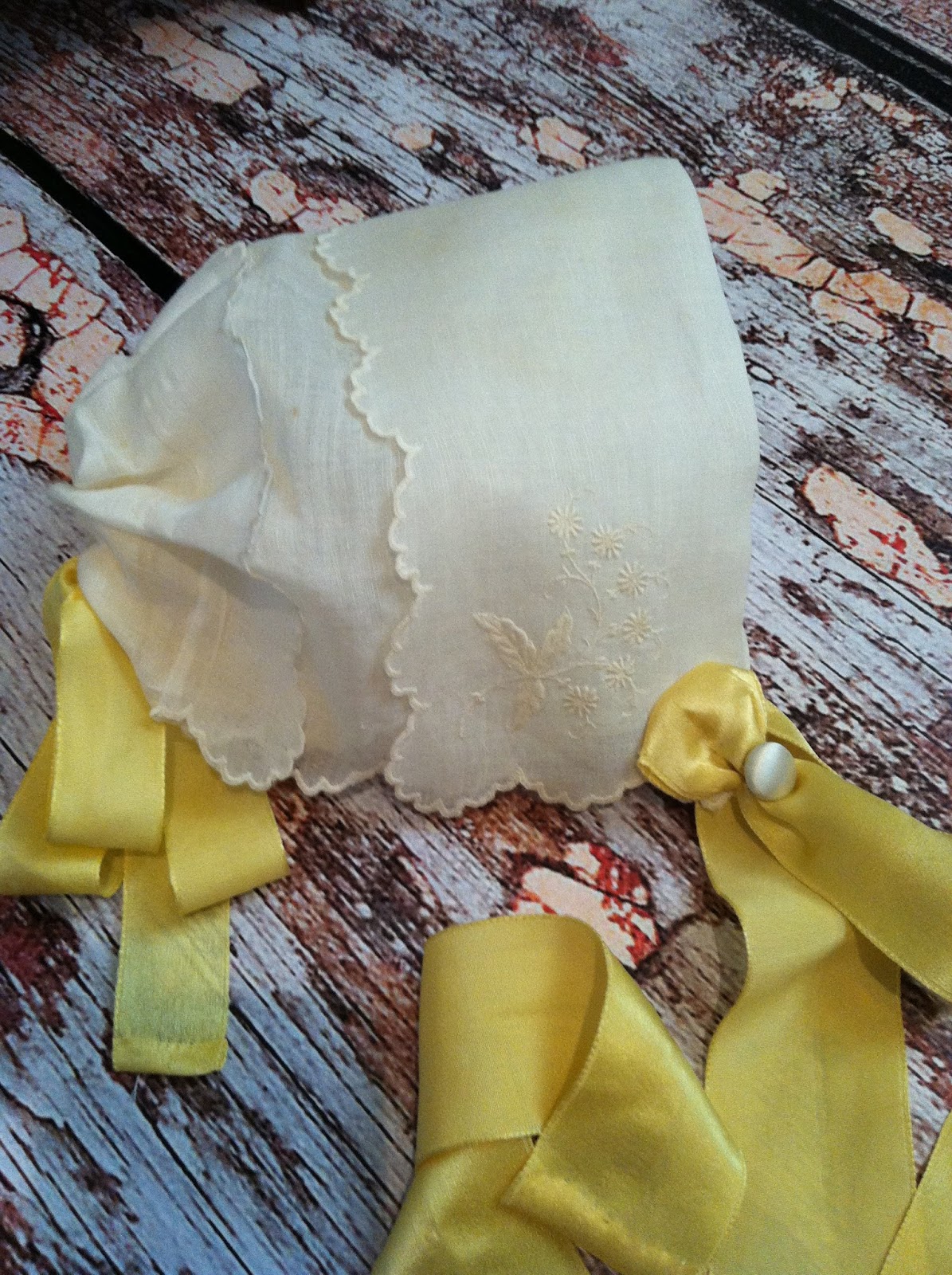
I usually make a bonnet out of the fabric; however, in this case, there was a hand-embroidered handkerchief carried by both the grandmother and mother at their weddings so I made a "Handkerchief Bonnet" and used the silk ribbon carried by both.  Yellow is not usually a color associated with a christening gown, but since it was a special memento of both weddings and the outfit was to be unisex, it worked well.


It always takes me aback when someone sends their cherished wedding gown to me - a total stranger - and asks me to cut it into pieces and create a new family heirloom.  Each and every one has a story to tell and this one in particular was very special.

Monday, October 10, 2016

Apple Pickin'

Apple Picking
When we moved to the Ozarks, the place we bought had only two little apples trees, which were only a few years old.  We have no idea what variety they are. I got serious about taking care of the trees and have pruned and sprayed (with dormant oil) at all the correct times.  I was rewarded with my first apple harvest (I'm not counting the ONE apple I got last year).  I got a total of about a dozen apples.  Not many, but it is the first harvest after all, and I'm hoping this next year both trees, and maybe even the two we planted a couple of years ago, will have some.

All the attention to the spraying schedule paid off.  There were only a few spots on the outside of a couple of apples that needed to be trimmed off.  There were NO bugs on the inside!! That's a big deal to me. I didn't spray the apples with any fungicide so the skins weren't pretty, but I didn't want to saturate them with poisons.

So Apple Picking was a big deal and a photo op of course.  The little ones picked the apples lickety-split and posed for Grandma.

Grandma may have photoshopped the apples just a bit so they look a little better.

After picking the precious harvest I knew I wanted to make some jam or butter with them.  Stephanie had made an Apple Pie Jam (recipe from Pinterest) but I didn't like the idea of any chunky-ness in my jam, so on to Apple Butter.  Again, Stephanie had found a recipe on Pinterest which turned out good, so I searched and found one.

The girls helped me peel the apples with the handy-dandy peeler Stephanie found at World Market.  It is amazing (and I don't use that word regularly) how quickly and easily it peeled, cored and spiral-sliced each apple.  So easy even a four or six year old can do it!  The girls peeled all but two apples and I had a little fun with the last two.

I added pumpkin pie spice and sugar to the apples and dumped it all in the crock pot to cook on low.  All the Pinterest recipes say to cook on low for 10-12 hours.

Well before the 10 hour mark, we went next door for dinner.  When I came back in I smelled SCORCHED apples!!!  I quickly scooped them out of the crock pot and into a bowl and into the fridge to cool quickly.  I haven't had the nerve to check it since.

Apparently I'm not the first to overcook apple butter.  Sister Dana did the same thing with a batch last year. Caroline suggested that she add some vinegar, can it and call it pork glaze.  So maybe I can salvage it after all.  Word to the wise: do not gamble your entire first year's apple crop on a Pinterest recipe.

Monday, September 26, 2016

Hand Made Shampoo Bars

My Hand Made Shampoo Bars
When I was a kid, my Dad used to tell us girls that we should just use Dial soap on our hair like he did.  Uh, no thanks Dad.

Fast forward a few decades...  I had not been happy with store bought shampoos for quite some time.  The only ones I really like cost $10 per bottle, with another $10 for the conditioner.  They are only sold in "natural" foods stores of course.  That's just not in the current budget, so I tried the cheapie shampoos - like Suave.  I found that those cheaper conditioners would break out my scalp so  I had to go back to the expensive "natural" shampoo and conditioner again.

When I started on the soap making journey, I joined some soap groups on Facebook and found out that shampoo bars could be made at home.  I found one recipe created by a lady who graciously shares her recipe and knowledge for anyone to use. It contains Apple Cider Vinegar, coconut oil, olive oil, sunflower oil, and castor oil.

This shampoo bar  is PERFECT for my scalp and hair.  It has just enough superfat (3%) so that I don't need a conditioner, but not too much, which would weigh down my hair.  I've been using it for well over a year now, and will never go back to store bought shampoo.

I infused olive oil with rosemary to use as the super fat in the shampoo bars (I allowed the herb to steep in the oil for some time, then strained out and discarded the herb).  Rosemary is supposedly good for hair, especially brunettes (which I no longer am...).  I add the olive oil to the soap and this extra amount is called superfatting. The rosemary has a very pleasant herbal scent.

I mold the shampoo bars in a PVC pipe.  When hard, I unmold and slice into bars.  I love the round shape - it fits nicely into my hand  and is a perfect shape for shampooing the hair.

There seems to be a lot of misinformation about using shampoo bars out there.  For one thing, I heard many people say that there was an "adjustment period" where the scalp, hair, etc. had to get used to this new way of cleansing.  Turns out, my research proved this is not the case at all.  There are all sorts of silicones, chemicals, etc., on the hair left by store bought shampoos/conditioners (which makes us think the product is leaving us with shiny manageable hair).  This creates a build up.  In order to remove any of this product from my hair, I first prepared a solution of 1 tsp. baking soda mixed with 1 cup of warm water and massaged that in my scalp, then rinsed.  I then used 100% coconut oil soap which is a highly cleansing soap - to shampoo my hair twice.  Then I used the shampoo bar.  That one-time process allowed me to remove any residual product residue from my hair. Now all that is being left behind each time I use the shampoo bar is a little bit of olive oil.  Caroline says blue Dawn dish liquid is the only thing that would strip the gunk for her.

One thing that I learned was that it was a good idea to rinse the hair with vinegar after washing.  For one thing, it brings the pH of the hair back down to normal levels (soap has higher pH than skin), and it helps rinse the soap out of the hair since I have hard well water.  If I had a water softener I probably wouldn't have to do this often.

I have found that I prefer white vinegar over apple cider vinegar.  I use about 1 part vinegar to 4 parts water. I use a recycled dishwashing detergent bottle for the vinegar and leave it in the shower with a plastic cup.  I squirt about 1/4 cup of vinegar in the cup and fill it with warm water.  I rinse my shampooed hair with this solution and then rinse it out well.

I have also made the shampoo bars and added tea tree oil, grapefruit oil, and other essential oils. Everyone seems to like something different.

My whole hair care routine has been dramatically simplified.  It's hard to believe that I am making this myself, using natural products that I have sourced myself.  I can't pronounce many of the ingredients in so called natural shampoos, but I have selected each of the ingredients in my shampoo bars.

It may surprise you to know that ALL soap is made with lye.  Soap cannot be made without it.  If a product says "bath bar", "body wash" etc. and not "soap", then it is a DETERGENT.  Basic soap is made by adding lye to water (or in the case of the shampoo bars, apple cider vinegar), then mixing with oils.  The end product (after much stirring) is soap.  Different oils lend different properties to the soap, and by adding extra oil, fragrance, essential oils, and/or botanicals, each bar is truly unique.

Thursday, September 22, 2016

Buttercup Squash Gratin

I found some seeds at the local farm store called Buttercup Squash.  I thought it was a type of pattypan, so I got some.  Cute little green squashes appeared on the huge trailing vines.  I picked one when I thought it was of eating size.  It didn't look like any pattypan I've ever had so we googled Buttercup Squash and found out it's a winter squash, and that little one I picked was too immature to eat.  We waited a bit longer.

When the squashes were a bit bigger, they were ready.  We learned that the skin gets a dark green and has a matte finish (no longer glossy).
  Source: Bonnie Plants


For the first day of Autumn, it was only fitting that we try Buttercup Squash for the first time.  I found a recipe on Pinterest (of course) and adapted it to my liking.

Source: The Kitchen is My Playground

The recipe comes from The Kitchen is My Playground.  The author uses Butternut Squash, and cubes it before cooking.  That's hard work - paring butternut is difficult.  Buttercup are a bit easier, but I took an even easier out.  I cut the squash in half, removed the seeds, and placed the two halves in the crock pot, set it to high and waited.  It took only about an hour to cook to fork-tender.  After cooking, I scooped out the flesh and fed the peel to the chickens. I saved the seeds for next year's garden.

So since my squash was very well done, I basically mashed it.  I followed the remaining recipe - well pretty much.  Here's what I did:

Saute 1 small (about 1/2 cup) finely diced onion in oil/butter in cast iron pan.  
When cooked through, but not brown, I added two garlic cloves, crushed.
I let this cook for just a couple more  minutes then turned off the heat.
Meanwhile, I beat one egg in a bowl, then added about 3/4 cup Parmesan cheese, grated, the squash, about 1/2 tsp. salt and a bit of freshly ground pepper, then the onion.
I placed this mixture in a buttered casserole dish, topped it off with about 1/2 cup additional Parmesan, about 1/3 cup Panko crumbs, and dotted the top with butter.
I microwaved the casserole for about 12 minutes (only because my oven is not working....) but heating in the oven would have been preferable.

The casserole was quite good and I plan to make this again.  

I do have quite a few of these squashes and while they can be stored for quite a long time, I will probably can most of them so I don't have to worry about spoilage.

Tuesday, August 4, 2015

Stocking Up - Produce Storage Tally for 2014

When the garden really started producing I thought to keep track of what we stored (frozen, dried or canned). I didn't keep track of what we ate fresh or things we didn't have enough to store. So in addition to the items listed below, we had fresh green peas, swiss chard, lettuce, spinach, kale, peppers, cauliflower, broccoli and so on.

Bok Choy
- Frozen, chopped - about 6 2-cup bags (not much, but then we didn't have many plants)

Butternut Squash
- about 10

Carrots
- Canned: 19 pints, 6 quarts
- Frozen: about 6 pounds

Corn
- Frozen
59 small packages (3-4 ears)
8 large packages (8 ears each)
Kernel corn (1 lb. each): 12

Green Beans
- Frozen: 10 pints frozen whole snap beans (for stir-frying)
- Canned: 23 Quarts, 1 pint (included snap beans and Roma Italian Style)

Fruits:
- Blackberries & Black Raspberries: Frozen, 6 gallon size bags
- Strawberries - Frozen, about 20 pint bags

Jams & Jellies
- Apple Butter - 4 half pints

Kale
- 6 pints frozen (for use in soups)
- 1 pint jar dehydrated (experimented)

Leeks
- 14 bags of two cups each (1/2 pound) chopped leeks (white part only)
- 1 coffee can full of dehydrated chopped leeks

Onions
- 40 pints (aprx. 1 pound per pint) chopped/sliced frozen
- two large coffee cans full of dehydrated onion slices

Pickles:
- Dill slices - 6 pints
- Dill Relish - 7 half pints
- Bread & Butter - 7 pints, 3 half pints
- Kosher Dill: 6 quarts
- Sweet Relish: 12 half pints

Potatoes
- 533 pounds harvested (not including what we dug and ate as "new" potatoes)
- Frozen: 8 pkg. 1-1/2 lb. each, boiled & peeled in Food Saver bags, as an experiment
- Canned: 13 quarts

Salsa (yes this is a food group)
- 67 pints, 3 quarts

Squash & Zucchini
- Frozen: 48 pounds total, plus about 6-8 hollowed out patty-pan squash & zucchini for stuffing

Tomatoes
- Crushed, Canned: 66 quarts, 25 pints
- Sauce, canned: 2 quarts, 33 pints, 8 half pints
- Juice, canned: 10 pints
- Spaghetti Sauce: Frozen: 8 packages; Canned: 3 quarts, 8 pints

This list also doesn't account for the onions, peppers, tomatoes, etc. that went into the salsa and spaghetti sauce - just the finished product is listed.